Voluntary Green Building Programs
Green Globes™
Green Globes™ uses performance benchmark criteria to evaluate the probable energy consumption of a building. Instead of comparing a building design to the performance of a hypothetical structure designed to ASHRAE 90.1 standards, Green Globes compares against data generated by the EPA’s Target Finder, which reflects real building performance – and specifically the better-performing buildings in the Target Finder database.
Recently, the Green Building Initiative (GBI), which owns the rights to Green Globes for New Construction and Green Globes for Continual Improvement of Existing Buildings in the U.S., completed the first ANSI-approved standard for commercial green building, ANSI/GBI 01-2010: Green Building Assessment Protocol for Commercial Buildings. The standard was derived from the Green Globes environmental design and assessment rating system for New Construction and addresses low-slope roofing.
To receive a final rating of one, two, three or four globes, the data submitted online must be assessed by a GBI-approved and Green Globes-trained licensed engineer or architect with significant experience in building sciences and sustainability. Using the project’s working drawings, building specifications, waste disposal plans, evidence of energy and life cycle modeling and other support materials, the assessor reviews the submission and confirms that the percentage of points achieved – which the system has determined on the basis of the answers to the Construction Documents questionnaire – is supported by fact.
Third-party assessment is optional but required for external recognition as a Green Globes certified building. Once an assessment is verified by a third party (including a site inspection), properties achieving a score of 35 percent or more receive a Green Globes rating based on the percentage of total points (up to 1,000) achieved. As many as 10 points may be awarded for 1-100 percent roof coverage with either vegetation or highly reflective materials or both. To qualify, materials must have a solar reflectance of at least 0.65 and a thermal emittance of at least 0.90, or a solar reflectance index of 78.
LEED®
The U.S. Green Building Council’s Leadership in Energy & Environmental Design (LEED) certification is a voluntary, continuously evolving national standard for developing high performance sustainable buildings. LEED provides standards for choosing products, but does not certify products.
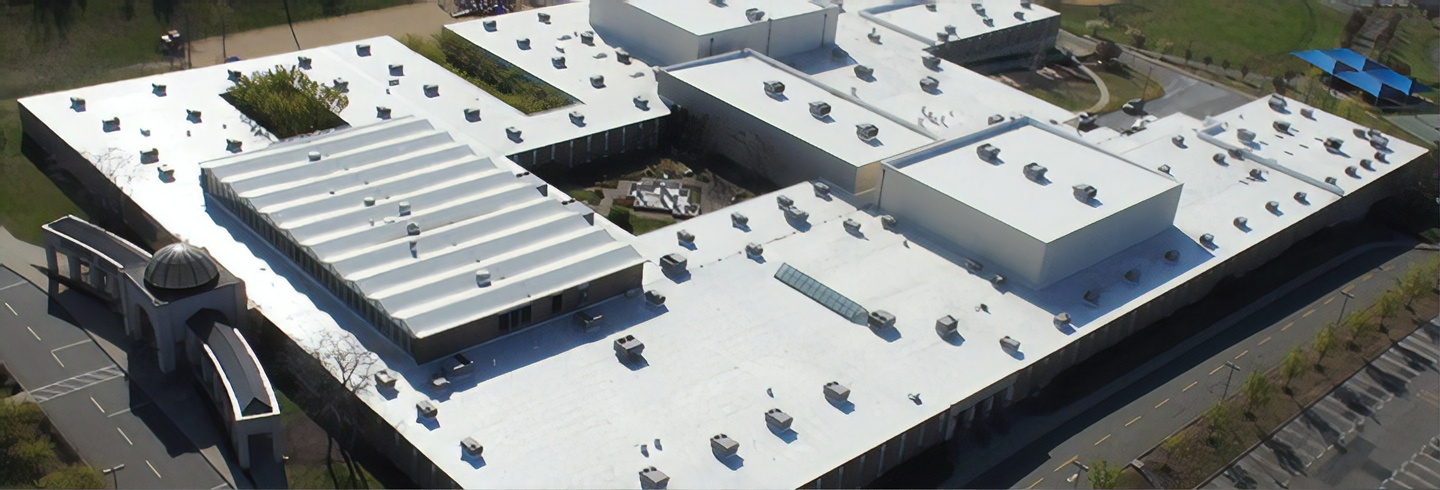
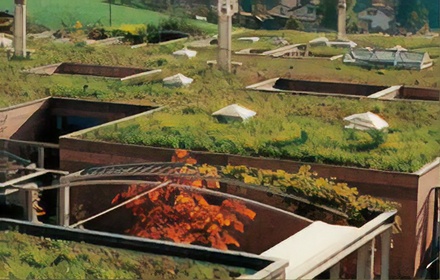
The criteria for Sustainable Sites Credit 7.2, Heat Island Effect: Roof, can often be met through the use of a white reflective vinyl roof or a green, planted roof. Specifically, the criteria call for using roofing materials having a solar reflectance index (SRI) of at least 78 for a minimum of 75 percent of the roof surface, or installing a vegetated roof for at least 50 percent of the roof area, or installing high albedo and vegetated roof surfaces that, in combination, meet this formula: (Area of SRI Roof / 0.75) + (Area of vegetated roof / 0.5) ≥ Total Roof Area. LEED allows for a lower SRI if the weighted rooftop SRI average meets the following criterion: (Area of SRI roof/Total roof area)*(SRI of installed roof/Required SRI) ≥ 75%.
Examples of LEED-certified buildings with vinyl roofs are:
| Building Name | Owner | Location | LEED Level |
|---|---|---|---|
| Donald Bren School of Environmental Science & Management | University of California,Santa Barbara | Santa Barbara, California | Platinum |
| McDonald’s Restaurant at Abercorn Common | Melaver Inc. | Savannah, Georgia | Gold |
| Frito-Lay Jim Rich Service Center | Frito-Lay, Inc. | Rochester, New York | Gold |
| Edifice Multifunction | Travaux Public et Services Gouvernementaux Canada | Montreal, Quebec | Gold |
| The Plaza at PPL Center | Liberty Property Trust | Allentown, Penn. | Gold |
| Combined Transportation Emergency & Communications Center | City of Austin | Austin, Texas | Silver |
| Management Building, Technology Square | Georgia Institute of Technology | Atlanta, Georgia | Silver |
| Seattle Central Library | City of Seattle | Seattle, Wash. | Silver |
| National Geography Society Headquarters Complex | National Geographic Society | Washington, D.C. | Silver |
| QS/1 Data Systems | QS/1 | Spartanburg, S.C. | Silver |
| 50 Sewall Street medical building | Olympia Development | Portland, Maine | Certified |
| Joseph A. Steger Student Life Center | University of Cincinnati | Cincinnati, Ohio | Certified |
| Immaculate Heart of Mary Motherhouse (renovation) | Sisters, Servants of the Immaculate Heart of Mary | Monroe, Michigan | Certified |
| Utah Olympic Oval | Salt Lake City Organizing Committee of the Olympic Winter Games 2002 | Salt Lake City, Utah | Certified |
| Premier Automotive Group North American Headquarters | Ford Motor Company | Irvine, California | Certified |
| Sat Com ETL Facility | Raytheon Systems Company | Marlborough, Mass. | Certified |
| Stata Center | Massachusetts Institute of Technology | Boston, Mass. | Certified |
| Duke University French Science Center | Duke University Office at the University Architect | Durham, N.C. | Certified |
Cool Roofing Codes,
Programs and Standards
Vinyl roof surfaces, also known as PVC membrane roofing,
can improve the energy efficiency of buildings while positively impacting the quality of the urban environment.
For more, click here »
Additional Reading
Review case studies, white papers & other authoritative background materials on PVC membrane roofing.
For all additional reading, click here »
Tested, Trusted Every Day – Environmental Profile: Vinyl Roofing Membranes
This brochure presents the most recent and reliable scientific data, complete with references, in response to questions about the health and safety of PVC membrane roofing...
Download full document [704 KB]
The Facts on PVC and the Environment
This presentation provides a detailed environmental overview of both the material vinyl and vinyl membrane roofing...
Download full document [1.5 MB]