
PVC roofing membranes can play a crucial role
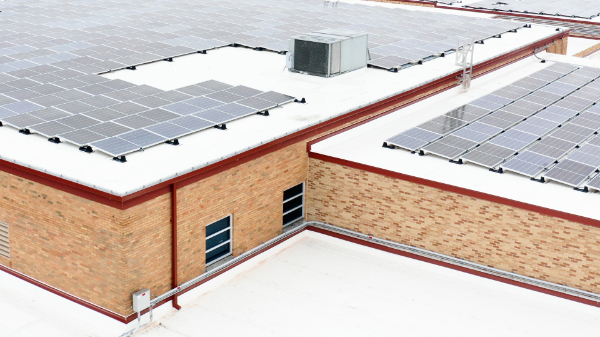
July 29, 2026—Rooftop solar panels arrays (also known as photovoltaic [PV] systems) are becoming more common in commercial building design, creating additional fire-design considerations for roof assemblies. The challenge many specifiers are facing is that maintaining a Class A fire rating is complicated by solar panels. The Coated Fabrics and Film Association-Vinyl Roofing Division (CFFA-VRD), the trade association for the PVC roofing industry, says PVC (vinyl) roofing is often the answer. When properly incorporated into tested roof/PV assemblies, mechanically attached PVC roofing membranes can help support Class A fire classifications.
Fire classifications for low-slope roofs are mainly determined under UL 790 and ASTM E108 standards, which evaluate flame spread, resistance to ignition, and the ability to withstand burning embers. The complication is that, once a solar panel array is added, the fire rating applies not just to the roofing membrane, but to the entire roof assembly. This takes into account the roofing membrane, insulation, deck, PV modules, mounting system, and installation configuration.
Rooftop PV systems introduce additional fire considerations, including localized heat accumulation beneath modules and potential ignition sources associated with electrical faults. As a result, maintaining a Class A roof assembly requires careful coordination of roofing materials and PV system components that have been evaluated together.
PVC roofing membranes are inherently difficult to ignite, exhibit very low flame spread, and self-extinguish quickly when a flame source is removed. Independent testing by the Southwest Research Institute’s Fire Technology Department has shown that PVC membranes can extinguish in less than one second after flame exposure, where other common single-ply materials may continue to burn for several minutes.
PVC roofs have also long been incorporated into UL listed Class A roof assemblies for PV installations, giving specifiers greater flexibility in rooftop solar array applications. For projects where maintaining a Class A roof assembly is important, PVC roofing membranes provide fire performance characteristics that can help specifiers achieve compliant, tested rooftop solar assemblies when used as part of an appropriate UL-listed system.
For more information, visit https://vinylroofs.org.